


Technical articles
FRP systems for the strengthening of reinforced concrete structures
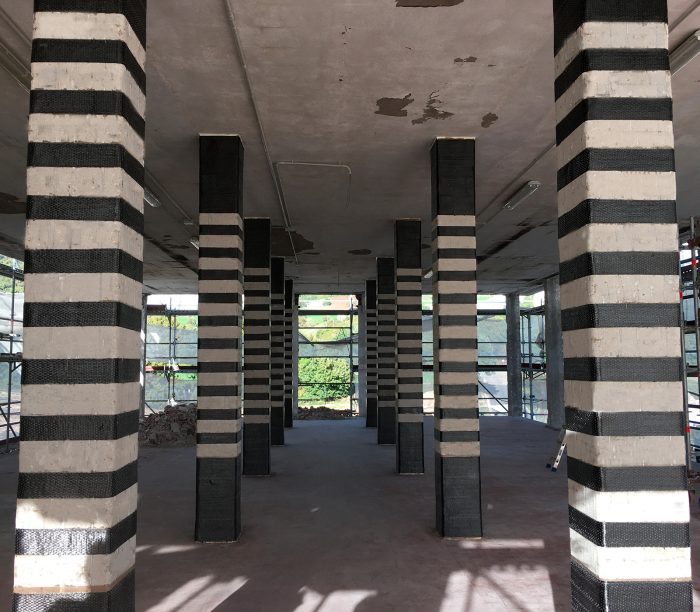
In the field of structural strengthening, FRP (Fiber Reinforced Polymer) systems today represent a technologically mature and widely adopted solution for the reinforcement of reinforced concrete (r.c.) elements affected by insufficient bending and shear resistance.
In particular, the use of carbon fiber fabrics – thanks to the high tensile strength of the fibers – makes it possible to increase the load-bearing capacity of beams, with a limited impact on structural mass and geometry and without significantly altering the global behavior of the structure.
However, experience gained on site shows that the real effectiveness of an FRP system does not depend exclusively on material certification – now an essential requirement – but on the ability to properly manage every application phase, from detailed design to installation.
It is in this context that the added value is not the single product, but the application know-how, technical support to designers, and on-site assistance to contractors during operational phases: fundamental elements to avoid recurring mistakes and ensure performance consistent with design assumptions.
Kimia, an Italian company specialized in FRP structural strengthening systems, offers a complete cycle for the reinforcement of r.c. beams using composite materials, developed from many years of field experience, even in complex and post-earthquake contexts.
Preparation of the substrate: the basis of an effective strengthening
Correct adhesion of the FRP system to the reinforced concrete substrate largely depends on the quality of surface preparation, a phase that must not be underestimated because it is decisive for the success of the strengthening intervention.
In the presence of deteriorated concrete, it is necessary to proceed with its complete removal by manual or mechanical chiseling, or with techniques such as hydro-demolition, until a sound, rough substrate free of loose parts is obtained.
Exposed reinforcement bars must be cleaned of rust down to white metal and subsequently protected with the passivating mortar Betonfix KIMIFER, applied by brush.
Volumetric restoration is carried out with suitable structural repair mortars from the Betonfix line, waiting for complete drying before proceeding with the FRP cycle.
If no restoration is required, the substrate must in any case have a surface tensile strength ≥ 1.5 MPa.
It is also necessary to:
- round off edges with minimum radius 2 cm;
- remove dust and contaminants;
- seal cracks and microcracks with suitable mortars.
All this ensures perfect adhesion of the FRP strengthening systems, avoiding detachments and premature debonding.
Priming and leveling of the laying surface
On porous or weak substrates, priming is required using Kimicover FIX, a two-component synthetic resin primer in water dispersion, with a minimum consumption of 0.2 kg/m².
The primer serves to:
- pre-consolidate the substrate;
- bind residual dust;
- improve adhesion of the epoxy resin.
If necessary, the surface is leveled with the epoxy filler Kimitech EP-TX, reducing the risk of stress concentrations in the carbon fiber reinforcement.
Epoxy resin and bonding of the FRP reinforcement
The next phase involves applying the two-component epoxy resin Kimitech CMP, with a minimum consumption of 1.2 kg/m².
The resin performs a dual function:
- adhesive layer for bonding the FRP fabric;
- impregnation of fibers to create the structural composite.
Correct application ensures effective stress transfer between concrete and carbon fiber.
Application of carbon fiber fabrics
The reinforcement is made with carbon fiber fabrics Kimitech CB or Kimitech CBA, cut to size and positioned according to the design specifications.
The fabrics are applied dry onto the fresh resin and rolled in the direction of the fibers to achieve:
- complete impregnation;
- elimination of air bubbles;
- formation of a continuous layer.
Alternatively, Kimitech VR 300 glass fiber fabrics can be used.
Site precautions: details that make the difference
During installation of FRP systems, some operational details are fundamental:
- roll in the direction of the fibers;
- work from the inside outward;
- keep tools clean;
- use airtight containers during site breaks.
These precautions improve quality, reliability, and durability.
Impregnation and multi-layer reinforcements
After laying the fabric, impregnation with Kimitech CMP is carried out until complete saturation.
For multi-layer reinforcements:
- apply wet-on-wet;
- or sand and reapply resin (0.5–0.8 kg/m²);
- stagger overlaps;
- avoid joints in the most stressed areas.
Anchors against delamination
In the case of poor substrates or complex geometries, the use of anchors against delamination is recommended.
Kimia offers in-situ connectors made with Kimitech FIOCCO CB, anchored with Kimitech CMP or Kimitech EPOXY CTR.
Final protection and surface finishes
To increase the durability of the FRP reinforcement:
- sprinkle quartz sand on fresh resin;
- skim coat with Betonfix RS, R30, or R52;
- or paint with Kimicover BLINDO.
Protection improves resistance to weathering, wear, and external aggression.
Kimia’s experience in structural strengthening and post-earthquake works
Kimia has worked for years in structural strengthening with FRP on buildings, infrastructures, and historic assets.
It is particularly active in seismic upgrading and post-earthquake restoration.
An example is the Renzini food plant in Norcia, strengthened after the 2016 earthquake with carbon fiber wrapping, increasing shear resistance and confinement effect.
Strengthening of r.c. structural elements with FRP: why choose Kimia
Choosing Kimia means relying on:
- certified FRP systems;
- long field experience;
- technical support to designers;
- continuous on-site assistance.
For technical information or support, click here to contact us:
https://www.kimia.it/en/technical-commercial-assistance